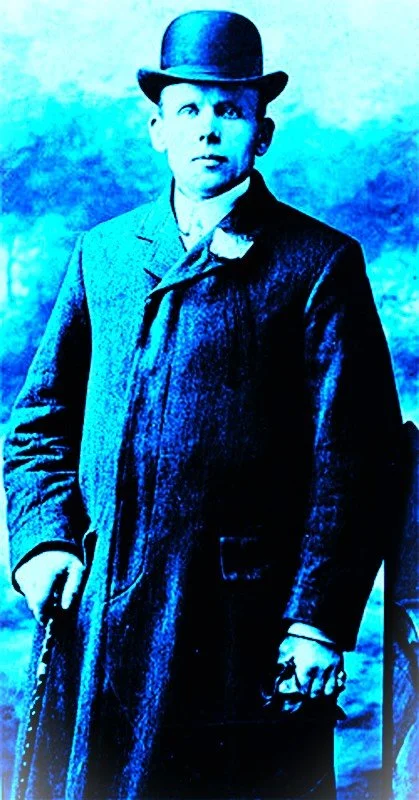
JOHN “BABBACOMBE” LEE
In mid-November 1884, a 20-year-old man named John Lee ran into a pub in Babbacombe, near Torquay, Devon, and cried out that “Miss Keyse is burned to death!” Lee was a footman in the household of Emma Keyse, 68, a woman of some means, reportedly once a lady-in-waiting to Queen Victoria. When witnesses rushed into the Keyse home (The Glen), they found her dead in her dining room. Her throat had been gashed, the right side of her skull bashed in. An attempt to burn her body had been unsuccessful, though, among other burns, her leg was seriously burned.
An inquest two days later concluded that Keyse had died as a result of “[w]illful murder by John Lee”. The evidence at trial, in February 1885, against Lee was, in essence, that he had been convicted the previous year of having stolen some £20 worth of silverware from his employer, and served six months. (How this entered evidence is unclear—there did not even seem to be any evidence he had stolen any of Keyse’s property). Keyse had known about Lee’s incarceration and wanted to give him a second chance. Lee was the only male in the house at the time of the crime. There was an apparently a small bloodstain on his clothes. There was some evidence, contradicted, that there was the smell of paraffin oil, a kind of lamp oil, on his coat and trousers. That was it. Lee was charged with murder. The jury deliberated for only 40 minutes, and Lee was sentenced to death.
Lee’s hanging was set to hang less than three weeks later in Exeter Prison. The scaffold had been moved to its new Exeter location in 1882, and Lee’s would be the first execution there. On 21 February the prison governor ordered the apparatus to be thoroughly overhauled, cleaned, and tested by the engineer officer and a warder carpenter. Later that day, the apparatus was tested, twice, by another warder and the hangman himself.
On 23 February, Lee was positioned on the drop (the trap door), and the hangman pulled an iron handle to open it. The drop moved but slightly and did not open, and it appeared to the Chief Constable of Devon that the two boards of the drop were jammed together in the middle. The hangman and a few attending prison officials stamped on the boards. Nothing. Lee was led away. The Chief Constable suggested that dampness had swollen the boards, and that a plane be applied—the prison engineer brought a plane “and a tomahawk” (!), and the edges of the boards were thereby “eased”.[1] A prison warder was made to stand on the drop (while hanging onto the rope), the iron handle was pulled, and the drop opened. Lee was again brought out, positioned on the drop, and the handle was pulled. Again nothing. Lee was again led away, and then brought out a third time. He stood on the drop. The handle was pulled. And again, nothing.
The prison Medical Officer intervened, and Lee was returned to a cell. The Home Secretary commuted Lee’s condemnation to a life sentence. An investigation finally revealed that one of the hinges on a bolt of the drop was 1/8th of an inch too long, causing binding. Lee, inevitably, became “The Man They Couldn’t Hang”.
Lee was released from prison in 1907, after 22 years. He toured the country giving talks. He married in 1909, but in 1911 ran away to the U.S. with another woman. He died in 1945, aged 80, most likely in Milwaukee.
\